Following the GitLab Dead Drop: Configuration Changes and C2 History
On 13 July 2026, a GitLab commit replaced a list of server names with api.cklomino[.]ink and api.dsfmot[.]xyz (the retained repository bundle and file history are documented in E07). The file held configuration, not a payload. The client reads its destination from this resource; changing the server list therefore changes where an unchanged payload can connect. The payload hash stays the same. The configuration history records the changing destinations, and certificate and panel observations connect one of those domains to a historical origin address, while the historical indicator reference lists every recorded resolver value, the separate unreferenced file, related lure hosts and the limits on each IP association.
The later July installer family used a separate mechanism; its upd_m, upd_w, upda_m and upda_w droppers embedded api.aazdias[.]ink as the primary store and api.fallaazdis[.]ink as the fallback, and those values came from the recovered dropper configuration, not from the GitLab config.json history. The origin association to 207.241.172[.]222 came from dated certificate and passive-scan observations, not a direct fetch from that address.
The payload fetches config.json from GitLab
Section titled “The payload fetches config.json from GitLab”The payload references this resource:
gitlab[.]com/drop-indexing/tasks/-/raw/main/config.jsonThe repository also contains a separate config-alt.json file with another pair of destination strings. Neither retained payload references it. Client use of this second file remains unknown.
The recovered JavaScript has its own hard-coded fallback, api.domatisc[.]ink, and a resolver function that requests the raw GitLab config.json resource, though no retained endpoint log confirms that a victim fetched either file. This code pattern is relevant to MITRE ATT&CK’s dead drop resolver technique (T1102.001). A payload with the same hash can receive different destinations depending on when it fetches this resource.
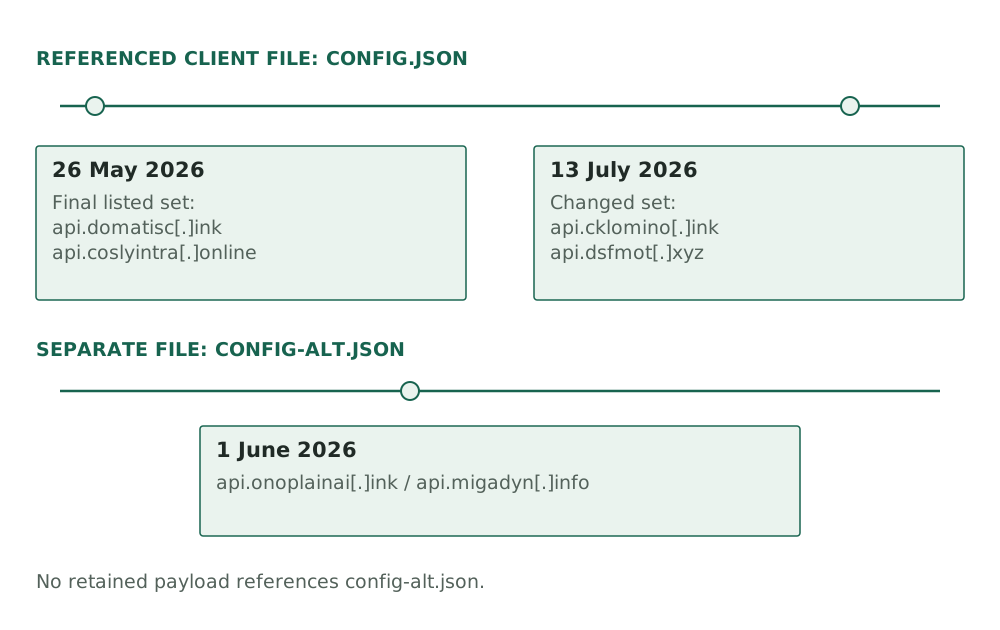
Figure 1. The referenced configuration changed in May and July. A separate file was added in June, but no retained payload references it.
Five May revisions, then a new server pair in July
Section titled “Five May revisions, then a new server pair in July”The primary file has five recorded revisions on 26 May, beginning with an initial set of domatisc[.]ink, coslyintra[.]online and valorecuiting[.]online, after which subsequent edits remove and restore an entry, introduce api. prefixes, and finally leave a set of two hosts. The recorded states after that, in order, are:
- 26 May 2026, final listed revision of
config.json:api.domatisc[.]inkandapi.coslyintra[.]online. - 1 June 2026, separate file
config-alt.json:api.onoplainai[.]inkandapi.migadyn[.]info. Its use by the recovered client is unestablished. - 13 July 2026, about 07:10 UTC,
config.json:api.cklomino[.]inkandapi.dsfmot[.]xyz.
Commit c3c71d65 replaces the primary destination set left by the May revisions, and the retained history contains six commits to config.json and one to config-alt.json (the latter is a separately recorded resource, not an evidenced client fallback).
Client refresh behavior determines when a configuration change takes effect. A client that fetches the file again may receive a new address, while one using a cached destination may continue trying the old server, and the retained history contains no client execution trace to resolve that behavior. Blocking a destination can interrupt traffic, while a client that consults this configuration resource may receive another address, so connection records are needed to identify the destination each client used.
A July hostname linked to a reported origin
Section titled “A July hostname linked to a reported origin”I compared the resolver hostnames with historical scan records to investigate the services behind them, and July scan notes associate 207.241.172[.]222 with C2 and administration services, and they record a certificate naming api.cklomino[.]ink and a third-party bare-IP scan that returned a Subtensor sign-in panel. The raw scan responses and certificate were not retained. The panel HTML and JavaScript available for inspection were retrieved from api.domatisc[.]ink, so they cannot independently reproduce the reported response from the bare IP.
The panel adds an application-level association to the certificate evidence, while further relationships came from certificate facets, passive DNS and reverse-DNS fields. These observations came from research-service records. The origin analysis did not directly scan the server or log in. E20 and E21 record the source and limits of those historical associations.
The July observations associated 207.241.172[.]222 with C2 and administration, 170.205.31[.]182 with lure hosting, and 23.137.105[.]75 with earlier C2 infrastructure. These roles describe the recorded periods. Current availability and ownership were not checked.
The SSH host-key search found no new address
Section titled “The SSH host-key search found no new address”The saved service enumeration listed SSH, HTTP and HTTPS. Its SSH profile included a host key, banner and handshake information, but these had different value as search pivots, as the common OpenSSH banner and handshake fingerprint matched broad populations of hosts, while the more selective host key returned only the address already known. The search found no backup address. Hosts absent from that dataset remain outside its coverage. The reported panel response did not enumerate every tenant at the address, and other services may have shared the address, so an IP block could affect unrelated traffic.
The 23 July certificates added hostnames
Section titled “The 23 July certificates added hostnames”The 23 July certificate enumeration added names that were absent from the inspected payloads: a dashboard host on the cklomino base, dev and hr mail subdomains on lure domains, and a hiring host alongside a career-themed API. The indicator reference records the names and first-issuance dates. These records identify certificate names, not proof that each host served a malicious application.
The certificates did not provide a cross-domain link. Subject alternative names stayed within individual registered bases, with combinations of the base, wildcards and subdomains such as api., www. and email., and no retained enumeration entry combined two bases in one certificate. Wildcards also mean that a new subdomain can appear without a new certificate-log entry.
Timing offered more context. Certificates for four bases were first issued on 13 July, the date of the resolver’s change to api.cklomino[.]ink and api.dsfmot[.]xyz. On 23 July, aazdias[.]ink and fallaazdis[.]ink were registered about six minutes apart through the same registrar and privacy service, with the same Cloudflare nameserver pair. Their primary-and-fallback naming repeats the earlier aavzx[.]ink and fallbaav[.]ink arrangement, and the current stores, a new dashboard host and several older lure domains also received certificates that day.
Shared panels and certificate automation can produce this cadence across unrelated customers, so I used the timing to check code and configuration relationships, rather than to assign hosts to the cluster. These registration and enumeration observations come from restricted 23 July records and are discussed in the paper, but are not independently reproduced in the public evidence exhibits.
A sweep of two /23 ranges belonging to the hosting provider covered about a thousand addresses; 291 exposed services. The provider used ordinary shared hosting. About twenty unrelated tenants ran services on port 3000, while the free scan dataset returned no results for the agent’s port 5173 in either range, and those observations make port-based hunting a poor discriminator: port 3000 was common among unrelated tenants, and the dataset did not cover the agent’s port. The results come from research services and have not been refreshed since 24 July.
Part 7 follows the target-acquisition tooling behind the two SQLite pools.